


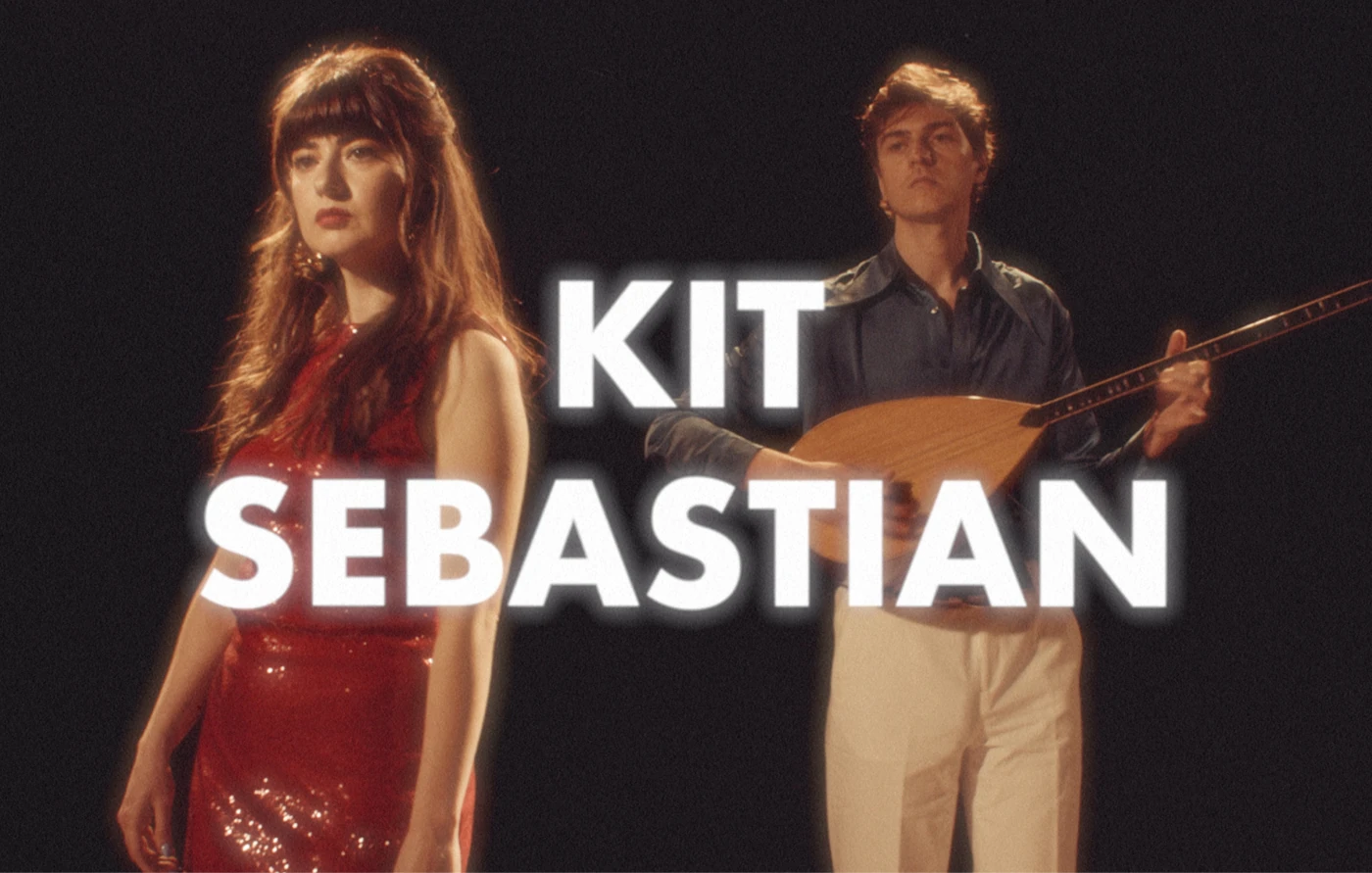
Kit Sebastian’s third studio album, New Internationale, climbed straight to the top of my Spotify listening a few weeks ago. The duo make music that resonates across different corners of the world. Four days after releasing it, they set off on an exhausting tour. They seem very happy with how things are going, nevertheless.
The band brings together K Martin and Merve Erdem, two musicians drawn towards deep emotional waters. Born and raised in Istanbul, Merve went to Italy to study cinema. She met K through a Facebook group. A French musician who had become interested in Turkish music, he was looking for a Turkish singer. The duo arrived in our lives with a rush in 2019. Their story reaches into Italy, France and Turkey, but for now they choose London.
Your third studio album is out. I imagine you’ve been busy. How are you feeling?
K: Four days after it came out, we left on a 26-day tour. We’ve just returned. Tired, but satisfied.
Merve: It felt a little frightening to bring the songs to the stage so soon after the release, but seeing people’s interest and hearing them sing along was wonderful. I’m quite tired now. The release was intense. I’m excited too.
On a scale of one to 10, how happy are you?
K: Six and a half. If it were any higher, I wouldn’t be able to make music anyway.
Is anything occupying your mind at the moment?
K: The horror in Palestine.
I know K joined a Facebook group to find a Turkish singer with whom to make music in Turkish. How did that idea come about? When and where did you first encounter Turkish music?
K: I knew some psychedelic songs existed and liked the music, even if only superficially. One day, I found a Fikret Kızılok seven-inch at a flea market in France. That was how my interest in Turkish music and culture developed.
People often call your music psychedelic, but you don’t particularly like the label. How would you describe yourselves?
K: Modernist global pop. Pop because we create memorable melodies; global because we want to bring very different cultures together through their differences; modernist because we separate ourselves from tradition.

Listening to Faust, I felt as if I were in a spy film. It has something mysterious, intriguing and unsettling about it. It is sexy and assured — made for a Bond film. Is there a dream duet or collaboration you would like to make happen?
K: Working with Thundercat would be wonderful. I think it would be a very interesting combination.
Merve: I’d love to work with Thundercat and Sven Wunder too.
What is your favourite song on the album, and why?
K: It changes constantly, but I’m really proud of The Kiss. We tried to fit the universe into that song while also capturing the dynamics of life and love, an important part of the lyrics.
Merve: Right now, Mechanics of Love. We haven’t played it live yet, and it hasn’t attracted much attention from listeners, so it still feels very new. I love its story.
Let’s talk about Göç/Me, which reflects on Merve’s experience of migration. How does being a migrant shape your music? I imagine Anatolian music and songs in Turkish are an influence.
Merve: Turkish music is in my DNA. It’s what I grew up with, more than an influence. When I first moved to Italy, there were weeks when I listened to nothing but Sezen Aksu.
Leaving home is complicated. What you remember, what you escape and what you miss change over time. Göç/Me captures that feeling. Until this album, because I was part of a band, I somehow felt I shouldn’t write too much about my own experiences. Our lyrics tended to be less explicit, more abstract.
Last year, I reached a point where, without Kit Sebastian, I might have left London, or the UK. That was when I felt the need to speak directly, as I do in Göç/Me and Metropolis.
Paylaş


How does preparing for live performance differ from working in the studio?
K: In the studio, you have to put your soul into the recording. You need to focus on yourself. Playing live is more about the connection you make with the other musicians and the audience.
Merve: We’re wilder on stage. The audience’s energy feeds us too. Some songs feel more emotional or harder live than in the studio.
Do you have a ritual before going on stage?
K: A few press-ups and a little whisky.
Merve: My rituals change all the time, but I usually like to be alone, do vocal exercises and ask the boys: ‘Which shoes do you prefer?’
‘Things can get difficult during mixing’
How do you give each other feedback? Is there a method that works for both of you?
K: We email each other or talk face to face. We revised this album many times.
Merve: We’re both very open to feedback and usually agree. Mixing can get difficult, though, because sometimes our ears pick up different details and we get lost in endless possibilities.
Merve, you recently paired a song with a dish on Instagram. Where did that idea come from?
Merve: I love cooking and good food. When we decided to share more about ourselves, I thought: why not include food? I’d like to do it for more songs. If I can overcome my laziness, making a New Internationale cookbook would be fun.
What is your favourite dish?
Merve: My mother’s dolma (vegetables stuffed with a savoury filling). I think once people try it, it becomes everyone’s favourite. She cooks it in sumac-infused water, which gives it a fresh, sour flavour. My second favourite is Yotam Ottolenghi’s vegetable quesadilla. I wish I could eat it every day.
Between you, you’ve lived in France, Turkey and Rome, encountering different cultures over the years. How is London treating you and your music?
Merve: It’s very open-minded and exciting. Wonderful things happen, and there are many independent venues making space for every kind of music. Financially, however, it is difficult, because unless you’re a very big artist, there isn’t enough funding.
There is a great deal of support and solidarity between musicians working in similar areas. Since Brexit, the music industry has favoured bands focusing on the difficulties of life in the UK, often post-punk and hardcore groups such as Idles and Yard Act. That doesn’t really fit us.
Your first gig memory?
K: A small Turkish jazz café in north London. I remember holding the guitar up beside my head so people could get past to the toilet or the bar.
Merve: The same gig. I printed the lyrics and put them on the counter. We didn’t know how to put on a show then. We’ve come a long way.
The song of your life?
K: Je ne sais pas, the 1972 version, by Jacques Brel.
Merve: Città vuota, by Mina.
Your favourite song for a sad day?
K: Jef, by Jacques Brel.
Merve: Yağmur, by Erkin Koray.
The most-played song on your Spotify?
K: L’Eau à la bouche, by Serge Gainsbourg.
Merve: Al Qalb Mrayef, by The Free Music — for this year, at least.


