


Martyna Marciniak’s work asks what truth looks like. The Polish-born, Berlin-based artist and researcher uses speculative fiction, spatial storytelling and 3D reconstruction to examine systemic violence, misinformation and human rights violations, exploring how technology reproduces prejudice — and how it might disrupt it.
She has worked with CNN, the BBC, Forensic Architecture, Amnesty International and Human Rights Watch, and co-founded Border Emergency Collective, which documents refugees’ experiences on the Polish–Belarusian border. Her work has been shown at the Warsaw Biennale, Kinema Icon in Bucharest, Haus Gropius in Dessau and Hong Kong’s deTour Festival, among other international platforms.
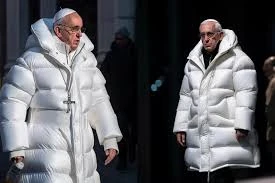
We encountered it at Ars Electronica Istanbul 2025, one of the city’s most exciting art events, hosted at Zorlu PSM in collaboration with Piksel.Creative Solutions. Her contribution, Atlas of Non-Fact, is perhaps her most overtly pop-cultural work. It begins with the image of Pope Francis wearing a white, Balenciaga-style puffer coat that went viral in 2023.
That picture became a landmark in the history of deepfakes. Created with Midjourney, it was so strikingly convincing that it spread almost immediately. ‘That image of the pope showed us all what generative AI can do, and how quickly this content can circulate,’ says Professor Hany Farid, a deepfake specialist at the University of California. At once plausible and absurd, it offered a glimpse of AI’s creative power and signalled a new era available to anyone with access to the tools.
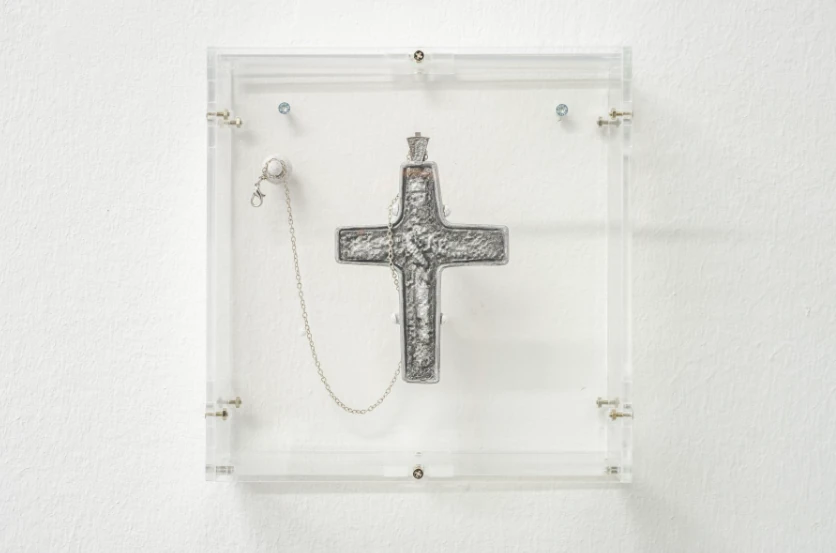
At Ars Electronica Istanbul, visitors encounter a physical version of the Balenciaga pope’s coat. Look closely: the impossibilities, mistakes and glitches of a synthetic image have been painstakingly reconstructed. References to the history of visual reality, from the baroque to the amorphous ‘blob’ aesthetics of contemporary AI imagery, are worked into its lining.
Ars Electronica, founded in Linz, Austria, in 1979, has become one of the leading platforms for media art at the meeting point of art, technology and society. Its festival takes place in Linz each September, while the Ars Electronica Export programme brings it to other countries. Istanbul is a stop on that network until 28 October. Marciniak’s Atlas of Non-Fact is among the projects asking visitors to consider how truth is produced — and distorted — in the age of AI.
The questions it raises stay with you for days, producing further questions inside each one. Preparing for this interview was far from straightforward. Marciniak’s answers, however, make her work intelligible even to someone at a considerable distance from technology.
You use speculative fiction and allegory to address systemic violence and visual bias. In a world governed by data, documents, rumours, AI and a lack of emotional intelligence, is fiction a form of resistance, or a way of expressing what data cannot?
Discussions of AI, in particular, can become excessively technical and complicated very quickly. By turning reality into fictional scenes, I try to show that although data and technology can seem inaccessible and overwhelming, misinformation in AI is fundamentally a systemic, political and economic problem, rather than a technical one. Fiction allows me to make these usually hidden systems and mechanisms visible — sometimes by deliberately exaggerating them.
In works such as Anatomy of Non-Fact, which we will see at Ars Electronica, you reconstruct viral or manipulated images, from the pope in a white, Balenciaga-style puffer to the fake explosion at the Pentagon. Are you trying to expose how misinformation works, or to question our desire to believe?
I examine these found images in depth, technically but also culturally, historically and theoretically. Reconstruction makes normally invisible technical processes tangible. It creates an opportunity to notice an image’s smallest details, which are often lost in today’s fast, uninterrupted stream of media consumption.
These reconstructions remind me that it is possible to stay with one image. By slowing it down, enlarging it and giving it a physical form, I try to reverse our quick, superficial relationship with images.

Do you want your works to function as evidence, or as aesthetic and metaphorical critiques of the systems that produce truth, news and information? How do you balance those approaches in practice?
It is certainly a form of critique, but also an attempt to develop a new vocabulary for visual literacy. In my research, a found image functions as a kind of evidence; its cultural or artistic value is not the deciding factor. My artistic practice operates within a different framework. Even so, I use my researcher’s gaze — what I call a ‘distracted gaze’ — to assess synthetic images critically. To some extent, that research experience and practice shape my art too.
When working with non-fact images that distort reality through visual manipulation, how do you identify and address the model’s own biases?
In this project, I frequently encountered black boxes: hidden technical processes, datasets and protocols. Early in the research, I tried to reverse-engineer the production process using a pool of source images I had collected. It gave me some basic insights, but no certainty. At the time, access to LAION-5B, one of the largest visual training datasets, had also been blocked for months.
One area that interested me was how compression algorithms process source data. An interesting observation emerged: they did not compress training images evenly. They compressed backgrounds far more than objects and figures. That follows something called saliency mapping, a sort of representational map of human visual hierarchy.
What is particularly interesting is that the resulting synthetic images do not imitate the way we look. They do not reflect what we actually see, or how we see it. Instead, they exaggerate, emphasise and multiply what we look at. The images therefore reinforce our selective visual perception, perhaps even shortening our already brief, superficial interactions with images.
In previous interviews, you have discussed the tension between techno-apocalyptic narratives and the gold-rush optimism surrounding AI. Working across art, law and media theory, where do you place yourself: hopeful, sceptical, or deliberately somewhere between the two?
I am more interested in how we talk about AI, and how that discourse and the beliefs it produces shape our political and economic reality. The biases and inequalities embedded in many datasets are reproduced through those narratives. We repeat frightening clichés while also describing AI in human terms. In fact, speculation around AI shapes our reality even more than the tools themselves.
I still hope this will lead to effective policymaking, and that growing collective discomfort will eventually become action. But I also worry that regulation will never keep pace with speculation. Perhaps the only hope is that the bubble will burst, allowing these tools to be used more critically and democratically. If AI accelerates and expands systems of surveillance, manipulation and injustice, that should be a call to repair those systems.
If the human eye can no longer trust what it sees — and it cannot — can we trust an algorithm to see events or images ethically?
No, absolutely not. An algorithm’s ethics are determined by its source data and the training process that shapes it. Ethics are not inherent in the algorithm itself. The danger became painfully apparent when Musk manipulated Grok to reflect his own worldview and political preferences.
What worries me most is how easy, appealing and dangerous it is to frame AI as a being capable of judgement. That idea rests on a desire to see AI as superior knowledge, or an arbiter of truth. We tend to give things we cannot understand a sacred significance, but we should not. Assigning AI an ethical role is misleading, and an extremely easy way to hand over human responsibility.
You work with organisations such as Forensic Architecture and Amnesty International, handling visual evidence of violence and surveillance. How do you manage the emotional and ethical tensions involved?
It depends entirely on the research context. In my previous work with Forensic Architecture, I mostly focused on police violence. We wanted to avoid the mistake of telling someone else’s story without understanding its context, because our own biases and privileges could obscure the truth. We therefore tried to bring the voices of victims’ families and communities directly into the process, and to work from their perspectives.
In other projects, such as war-crimes investigations with Human Rights Watch, you work with far more sources and cannot always establish that personal relationship. Whenever possible, though, we try to make that voice part of the research.
When you work with people who have witnessed unimaginable things or lost loved ones, all you can hope is not to let them down — and to work throughout the process without retraumatising them. It is an extremely delicate balance.
When witnessing real suffering, is there a boundary between an artist’s responsibility and a researcher’s?
As a researcher, you usually encounter distant images and unfamiliar scenes, and often approach them analytically. Everyone doing this work has a different experience and their own ways of coping. I tend to move between an analytical and a personal perspective; the balance shifts with every project and context.
As a researcher, I feel responsible for showing, explaining and recording an injustice. In my art, however, I do not like making other people’s suffering a material or a focal point. Turning someone else’s pain into the source of my work feels problematic, exploitative, even dishonest.
There are exceptions: if I have a direct relationship with the place, the people or the event, or if the issue is so far-reaching that it affects all of us — state surveillance, economic devastation or the climate crisis, for instance — that boundary can become a little more flexible.
As an artist and researcher who has returned repeatedly to these subjects and this suffering, how does it feel to exhibit in a country where human rights are openly violated, and violence towards both people and animals is no secret?
If you look at the history of open-source intelligence, or OSINT, and visual investigations — the Syrian uprising in 2011 and the regional revolutions around that time, for example — you can sense the hope that existed then. A new era of citizen-generated imagery was emerging. The visibility of political movements, and the atrocities documented by protesters, offered a form of counter-surveillance against state violence and systemic injustice. Every video and recording on a researcher’s or journalist’s desk is valuable: it is a space of testimony.
Now we are in a different period, an age of visual oversaturation. Everything is visible, while verification mechanisms, data access and platform APIs disappear. Despite the unprecedented volume of documented human rights violations, governments’ denial or indifference exposes a crisis of visibility.
We need to demand higher standards from social media platforms, monitor policy changes, share data carefully and develop a more nuanced relationship with images. We should also demand greater visual literacy in the courts. Discussion of visual evidence must not be reduced to ‘real’ and ‘fake’. These binaries feed a value system that weakens democracy: good and bad, trustworthy and untrustworthy, us and them. Defending truth now means questioning how we see, as well as what we see.

This last question comes from ChatGPT. I showed it your work, explained it and asked it to prepare five questions for you. I chose this one: you present the errors, or glitches, in the images I generate as an aesthetic quality. If one day I correct those errors and become flawless, where will art live? In other words, how might my perfection conflict with your freedom of expression?
I am not afraid of you stealing my freedom of expression. I think art will continue to live in human stumbling, in imperfections and odd missteps. But I worry that bringing you and tools like you into creative processes will raise expectations of artists: produce faster, work with smaller budgets, be more efficient.
I think that will happen, but not because of your perfection. It will happen because the industry has accepted you so unquestioningly. Likewise, when it comes to misinformation, I am not frightened of your flawlessness. The real source of misinformation is neither technological sophistication nor how closely AI images resemble reality. The threat lies in social media platforms’ lack of oversight, their dependence on financial systems, the absence of verification and the relentless encouragement of quick, superficial engagement with images. The danger is not in your code. It is in the world turning us into eyes that look quickly, without thinking.
The international media-art festival Ars Electronica takes place from 21 to 28 October, in collaboration with Zorlu PSM and Piksel.Creative Solutions. Related link
Paylaş


