




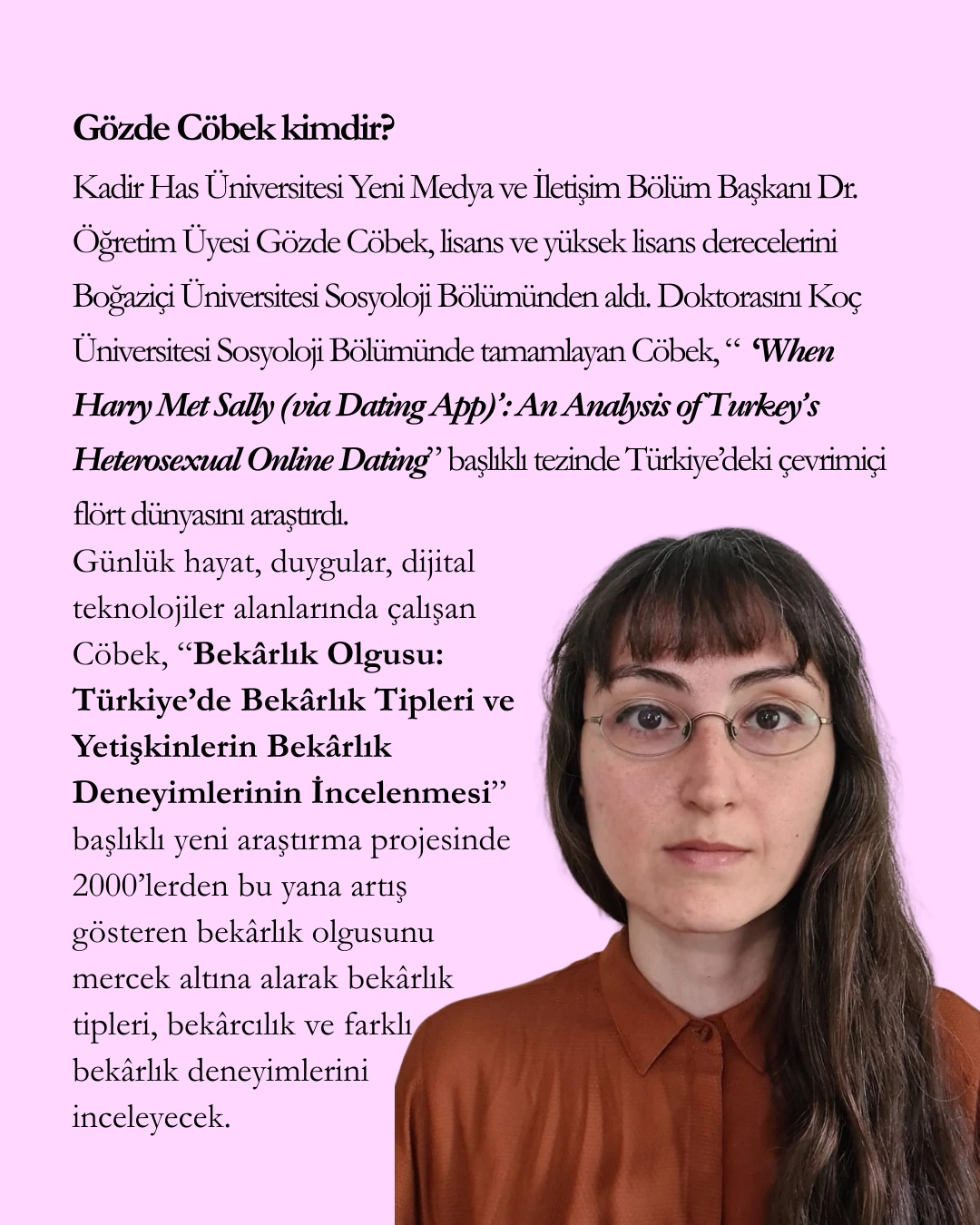
Once we’ve made it through 14 February — once everyone has spent enough on Valentine’s Day, made enough content, felt loved-up or utterly alone — we can move on to 15 February, pop culture’s day for singles. To talk about single life, we knocked on the door of Dr Gözde Cöbek, head of new media and communication at Kadir Has University. The subject, we discovered, is deeper and more serious than we imagined.
How did single life come onto your radar and become a research subject?
For my doctoral thesis, I studied heterosexual online dating practices in Turkey. Afterwards, I wanted to broaden that research and focus on single life. There are relationship crises developing alongside dating apps, and the apps are blamed and made scapegoats. I discussed that in my thesis too.
Are dating apps really scapegoats?
There isn’t really a single scapegoat. Technology and culture interact to produce these crises. Since the 2000s, the number of single people has risen significantly. It isn’t just Turkey: globally, marriage rates are falling and divorce is increasing. The initial explanations are the individualisation associated with neoliberalism and the women’s movement.
Dating itself began as women became more visible in public life. Entering education and employment in greater numbers, they encountered the opposite sex more often, helping bring dating into being. Rather than arranged marriages, people began meeting and choosing for themselves.
Research now points to a gap between women’s and men’s educational attainment. Women are more educated than men. That has created space for greater feminist awareness, a clearer understanding of the problems patriarchy creates and greater awareness of gender. As a result, women are more financially independent and seek people who match them intellectually. When they cannot find them, they may choose to stay single.
So it’s women’s fault again?
Not fault, but that is one explanation offered by research. There is also the fact that young adults, those aged 18–29, are postponing marriage and choosing to remain single because of the demands of life.
What do we mean by single? Everyone who isn’t married?
The dictionary definition used to be someone who had never married. Then relationships outside marriage, increased cohabitation and different forms of partnership emerged, and the definition widened. Now we can define a single person as someone without a partner. They might be divorced, never married, looking for a relationship or not looking. Anyone without a partner is placed in that category.
There are two forms of singlehood. One is voluntary: choosing to be single and not wanting a partner. The other is involuntary. We aren’t referring only to incels; that is a different subject. Here it means people who want a partner but cannot find one. With the rise of voluntary singlehood, research increased after the 2000s. The literature describes it becoming a way of life.
What does the research in Turkey look like?
There are studies of what we call singlism: social prejudice against single people. Ceren Lordoğlu’s Being a Single Woman in Istanbul was published as a book by İletişim. Building on that, I wondered who in Turkey chooses to remain voluntarily single.
It isn’t only gender. Age, class and perhaps religious beliefs may also shape these forms of singlehood. I began asking those questions. Turkey has considerable geographical and cultural differences. Being single in a big city will be a very different experience from being single in a provincial setting. Working from that premise, I developed a research project. I am now planning a detailed nationwide study using survey interviews.
The Economist published what I think may be the most detailed article so far on rising singlehood and its consequences. It gave figures suggesting singlehood had doubled between 2013 and 2025. What do you expect Turkey’s figures to show?
We haven’t collected data yet, so I can’t say. What I can say is that the significant rise in single people has prompted government initiatives. It was one reason last year was declared the Year of the Family. We see increasing emphasis on marriage and family: ‘These young people no longer want to marry; let’s get them married.’
Why is being single seen as a problem?
Because marriage matters to population management. With the emergence of nation states, it became an important issue. From the perspective of population policy, people need to form families so the population can continue and sustain itself; nobody should remain single. There was even discussion of a singles tax in Turkey’s early republican period. Studies examine it: impose an extra tax on single people to encourage marriage and family formation.
Where does that lead us? In the 2000s, singlehood studies moved beyond voluntary singlehood and its different forms. Academics introduced the concept of singlism because their research showed people suffering inequality and disadvantage because they were single. I think we can translate it into Turkish as bekârcılık (prejudice and discrimination against single people).
The term emerged in 2005. Research found certain qualities attached particularly to singles: fiercely independent, promiscuous, selfish. They are perceived as more selfish or irresponsible, with social assumptions that this is why they lack a partner. There are even judgements such as ‘single people are dirtier’. The research shows how negative ideas attach to singles around the world.
Some Turkish studies show this too. Single people do more overtime than married people. When a job must be finished after hours, single employees are chosen. Why? One person has a family and children and needs to go home, while the single person is treated as though they have no private life and can work around the clock. That is one form of discrimination they experience.

As singlehood becomes more common, are labels such as evde kalmış (someone regarded as having missed their chance to marry) becoming less common?
I can’t make that claim. The label matters because it still exists. Think of relatives at holiday gatherings asking: ‘Is there someone in your life? When are you getting married?’ Once you marry, the questions about children begin. Beyond a certain age, expectations are entirely centred on family. It happens around the world.
The French sociologist Marie Bergström, for instance, says that being in a couple is seen as the norm, especially after your thirties begin. In your twenties, there is room to establish a life and discover yourself; in your thirties, the pressure starts. That is why I think examining these age thresholds is valuable.
In studies of voluntary singlehood, people call it freedom and genuinely see it as a lifestyle. In involuntary singlehood, it is a problem, a phase to escape as soon as possible. There are expectations: finish your education at 18, find a job, find a partner along the way, then marry. That is where the idea of evde kalmışlık (having been left behind in the marriage timetable) arises.
Nobody calls a 20-year-old evde kalmış (past their supposed chance of marriage), but from 30 onwards the label can be attached to single people. How much these prejudices have softened, and how much they affect people’s lives, are things I can only report at the end of the research.
You mentioned incels. Can we say they are a group contributing to the rise in singlehood? Which category do they belong to: involuntary singlehood?
This distinction is important. Involuntary singlehood does not mean incels. The term incel is often translated into Turkish as ‘involuntarily single’, but that is not right. That may be its literal rendering, but we cannot attach the incel label to every man who wants a partner, cannot find one and does not want to be single. Incels are an organised online community: a subculture, a digital cultural community.
Much of the research on incels has been done in America, so we are generally talking about a white, extremely racist and profoundly socially isolated group. They aren’t rejected only by women but by society. It is a community strongly associated with gaming culture, and with organised digital groups, particularly on Reddit, linked to what is called the alt-right.
There is also a female counterpart, the femcel. Calling all involuntarily single women femcels and all involuntarily single men incels, then generalising that involuntarily single people produce hate speech, hate women and men, and are sexist and racist, is neither scientific nor correct. Involuntary singlehood is something else.
Incel culture, however, is prone to violence, demeans women and directly blames them. Ultimately, the literature points to this: as women gain more equal rights and feminist awareness grows, nobody has to endure the other person any more. As women’s need for men diminishes, the anger and accusations directed at them by misogynistic subcultures increase.
As women become more financially independent and accumulate cultural capital, they look for a partner who suits them: someone who will not control them, take away their freedom or make the relationship unequal, who will show them equal respect and not hate women.
In summer 2024, some musicians and influencers in America and Britain helped start a ‘return to virginity’ movement. Women pledged not to sleep with anyone for a summer, called it a ‘celibacy summer’ and shared how many days it had been since they’d had sex. Meanwhile, this year’s relationship trends suggest women are increasingly dating men about five years younger.
Keeping up is particularly difficult for generation X. I see women adapting faster, as central figures in neoliberalism, while men their age fall behind — and younger men bridge that cultural gap. Will the greater open-mindedness of generation Z and those after them increase voluntary singlehood too?
One of the biggest social clichés is that the man should be older. As men age, they turn towards younger women. This has been much discussed in Turkey lately because of television dramas. A 40-year-old actor doesn’t want a woman his own age as his screen partner. She should be 20 at most. It happens in real relationships too; the literature says so.
This needs much deeper research, but why shouldn’t women look at younger men? There are people around me who married or are dating someone three or four years younger. I also know couples with a 10-year gap. Why not? To understand the reasons, though, we need a detailed investigation.
I see a paradox. Rising singlehood affects the economy and changes shopping habits, but being single is expensive. With today’s rents and bills, it feels as if we already pay the singles tax you mentioned. On the other hand, meals, nights out and holidays for two cost extra too. How do increasingly difficult economic conditions around the world affect the choice to stay single?
That interests me too: what are the economic factors in single people’s experiences? With rents rising so much that living alone has become almost impossible, not sharing bills or holiday accommodation puts all the costs on one person. Travelling alone means a different financial experience from that of someone with a partner.
For involuntarily single people, those economic experiences also help explain why they don’t want to be single. You want to share things, material and emotional. Not just emotional difficulties, but financial ones. Keeping up that financial struggle alone is psychologically and emotionally exhausting. Wanting to share it can be another reason not to want to be single. These are social conditions, not matters belonging to one individual alone.
Do you know of government support for people living alone in other countries? Policies usually encourage marriage, particularly through tax and health insurance. Being married is an advantage in Europe and America…
I don’t know of any, honestly. But the rent crisis has become global, so many single people now have to live with others. Not only in Turkey, but in New York, London, Paris, Barcelona, Madrid and other major cities. Rents are in serious crisis there too, and because people can’t carry the cost alone, many are moving into shared homes. The person you share with might be your partner. There is even discussion of how living alone increases factors contributing to the climate crisis.

You mentioned television dramas. In older Turkish series such as Şaşıfelek Çıkmazı and İkinci Bahar, women seemed more real: women with younger partners, divorced women with children, strong women. Today, single women tend to be innocent young girls, scheming women or malicious mothers-in-law — portraits that disparage them again. Reading television culturally, what do you see of singlehood in Turkish drama?
That is a good example of singlism: how dramas reproduce it. The male partners’ characteristics, actors in their forties wanting women in their twenties, while women their own age play mothers — all are meaningful. Dramas generally focus on people in their twenties, at most their early thirties. There is ageism too.
Why not a drama about people in their forties? Why must they only be mothers, fathers, or even grandparents? We see single men in their forties, but not single women. The men are represented through womanising. That is also a recurring theme in singlism research. Studies in America and Britain show single women over 30 labelled ‘crazy cat ladies’.
Discrimination through these stereotypes, and its effects on individuals, also need to be examined. Television dramas affect us a great deal.
Finally, since dating apps are also your area of expertise: there are theories that apps, AI companionship, dating bots and even robots will push more people towards singlehood. How much truth is there in that? If it continues, will love between two people become an old concept found only in art, films and songs?
I think it is too early to examine AI’s effects and discuss conclusions. AI is now being integrated into dating apps, for instance.
But I can say this about love: as a feeling and a concept, its meaning has been changing since modernity, as other feelings have. Shame is the same. Emotions change their meanings according to social and historical conditions. Political, economic, cultural and technological conditions continually change, and some concepts’ meanings change with them.
The concept of love in early modernity was worlds apart from today’s. But did love exist then? Yes. That is why I don’t agree with claims that ‘love is dead’. Love isn’t dying. Its meaning is changing, and that is what we should examine. How is it understood now? How is it defined? What sort of feeling has it become?
There are so many relationship concepts now, from situationships to ghosting. We need to ask what love is today. How has it changed, rather than has it disappeared? That is the more important question. Love won’t die. Hatred won’t die. Shame won’t die. These concepts will always exist.
Paylaş


